
Pathways
Lingwell meets people in real moments, such as before appointments, after hard days, during grief, recovery, overwhelm, or uncertainty. It is even good for moments when someone feels off but doesn’t know where to place the feeling. Each pathway is tuned for a different type of moment, but they all draw from the same calm, supportive, and agency-centered core. Users can select “Open Conversation” for open reflection, or a specific pathway that brings tone, structure, and targeted guidance for particular needs.
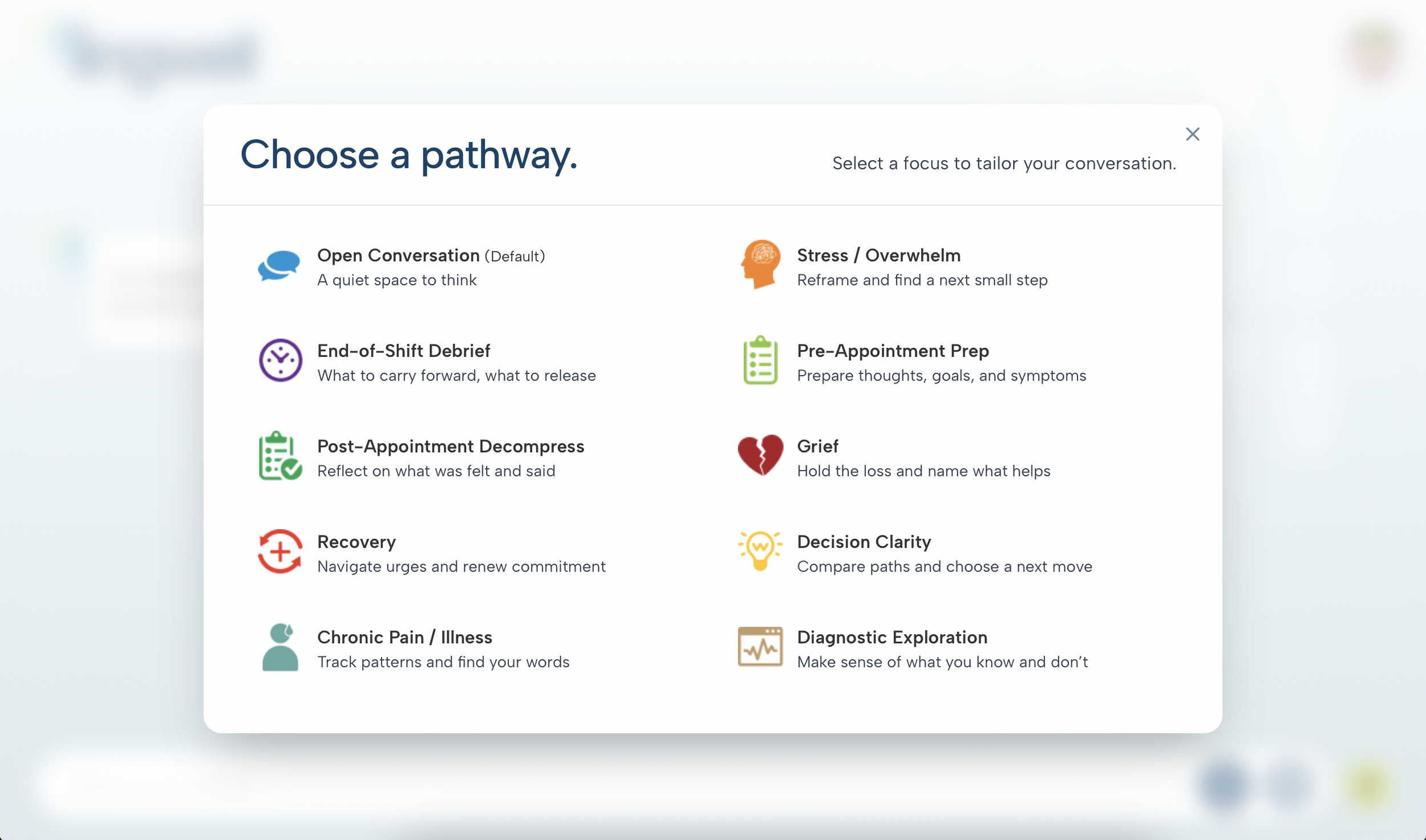
Each pathway is a lens that guides the focus and tone of individual’s language exploration, tailoring Lingwell to their situations. When someone chooses a pathway, the conversation flow adapts so the words they produce and the summaries they get reflect the context they are in, whether that is preparing for an appointment, navigating recovery, processing grief, or talking to themselves honestly.
Pathways change:
how prompts are framed
what the system focuses on first
the type of structure emphasized in the final narrative
the contextual priorities (self‑reflection vs. planning vs. interpersonal communication)
Core Pathways
Open Conversation (Default) — A quiet space to think it through. No pressure. Summary only if requested.
Stress / Overwhelm — Reframe thinking about the scale of the moment. Choose one small next move.
End-of-Shift Debrief — Capture important moments: what they pulled from, what to carry, what to let go.
Pre-Appointment Prep — Clarify purpose, collect top questions, name one hard thing important to say.
Post-Appointment Decompress — Reflect on what was discussed, what was felt, what was decided.
Grief — Hold the loss without fixing it. Keep a memory close, name what helps, find a way to honor the moment.
Recovery (change, sobriety, habits) — Talk through cravings. Notice triggers and wins. Commit to the next small step.
Chronic Pain / Illness — Track patterns without catastrophizing. Find words to explain it to others.
Decision Clarity — Lay out options and trade-offs. Pick a next experiment.
Diagnostic Exploration — Sort knowns/unknowns, gather questions, and map next moves without spiraling.
Custom Pathways (for clinics, programs, teams)
For contexts with recurring needs, Lingwell can tailor a pathway to integrate to voice and workflow.
Examples:
Oncology intake prep
Rehab weekly check-ins
End-0f-shift for ICU, ED, or crisis teams
Student conduct reflections.
Spiritual care debriefs

How Access Works (Individuals & Organizations)
Single-use link or QR: One-time access for a single summary. Ideal for waiting rooms or simple, low-lift support.
Time-limited pass: Private access for a set window (e.g., a week or month) to selected pathways. These are common in recovery, campus referrals, or support programs.
Full subscription: Ongoing access to all pathways for consistent personal or professional use.
Organization specific QR codes can route to the right pathway (e.g., Pre-Appointment) and optionally attach a clinician or organizational leader. Users can stay anonymous. No account is required when entering via link/QR.
Summaries are always user-controlled, and sharing is opt-in.